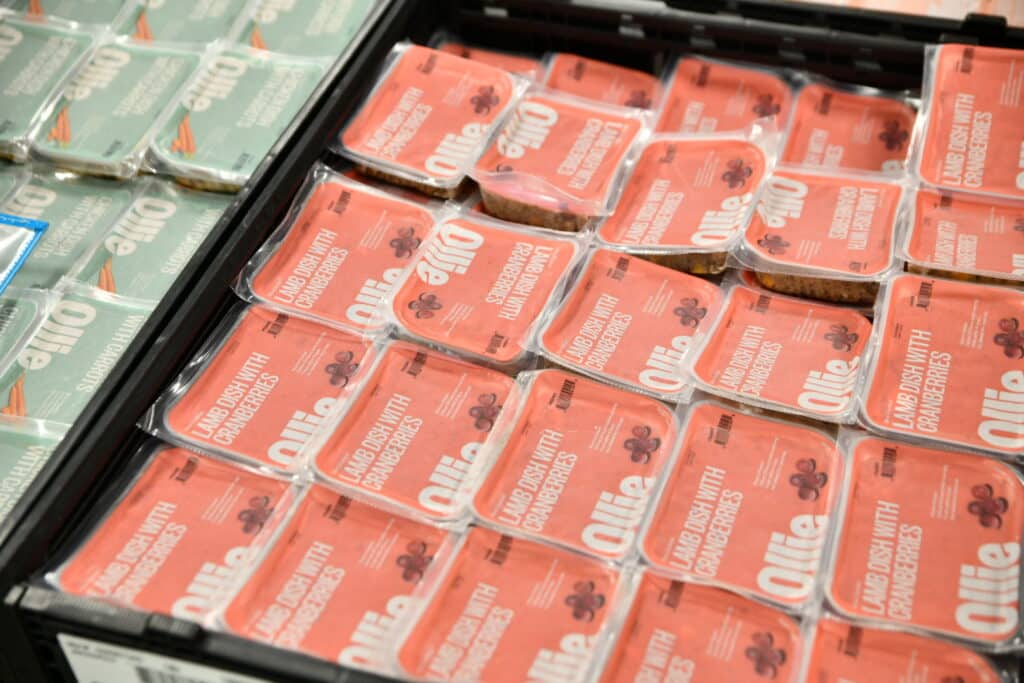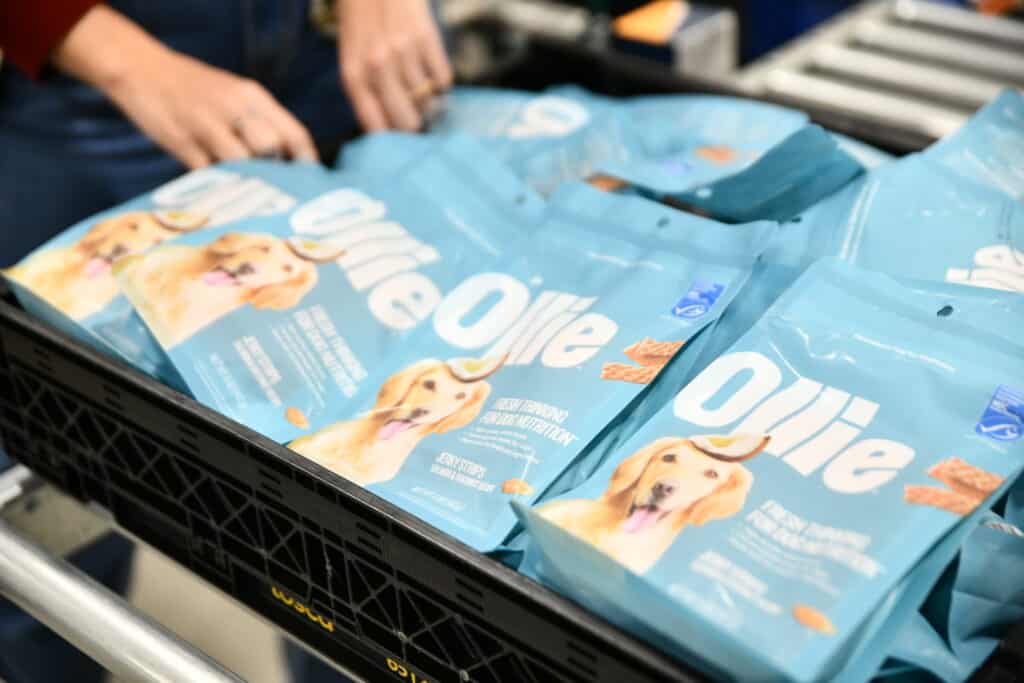








How Ollie reduced packaging waste while scaling its pet food operations
Scaling a fast-growing food brand requires more than increasing production capacity. Every part of the supply chain from fulfillment operations...

Protect product quality, gain efficiency, impact sustainability goals, and create bottom-line savings in one move.

Fewer out-of-stocks, higher product quality, greater sustainability impact.

Improve throughput, optimize storage, and reduce rejections.

Drive efficiency and enjoy faster, smoother DC operation.
Access solutions and perks that green your operation and save you money. From planning to implementation, we are with you every step of the way.
See how this leading grocer improved efficiency and sustainability by switching to Tosca RPCs. Learn the real-world impact and results in this customer success story.
Discover inspiring customer stories that highlight how our solutions have made a difference.

See why the world’s top retailers & suppliers partner with Tosca.

Reduce emissions, eliminate waste to landfills, and conserve energy.

Learn about our 60+ year history, mission and values, and leadership team.

Customize assets to meet your needs with our in-house R&D experts.

See our global network of service centers, get contact information, and directions.

Be at the forefront of sustainability with a talented team. Apply now.
Protect product quality, gain efficiency, impact sustainability goals, and create bottom-line savings in one move.
Fewer out-of-stocks, higher product quality, greater sustainability impact.
Improve throughput, optimize storage, and reduce rejections.
Drive efficiency and enjoy faster, smoother DC operation.
Access solutions and perks that green your operation and save you money. From planning to implementation, we are with you every step of the way.
See how this leading grocer improved efficiency and sustainability by switching to Tosca RPCs. Learn the real-world impact and results in this customer success story.
Discover inspiring customer stories that highlight how our solutions have made a difference.
See why the world’s top retailers & suppliers partner with Tosca.
Reduce emissions, eliminate waste to landfills, and conserve energy.
Learn about our 60+ year history, mission and values, and leadership team.
Customize assets to meet your needs with our in-house R&D experts.
See our global network of service centers, get contact information, and directions.
Be at the forefront of sustainability with a talented team. Apply now.
Ask any supply chain executive where their biggest cost pressures are, and you’ll hear the same answers: labor, freight, and automation investment. Packaging rarely makes the list. Yet packaging is the one operational variable that touches every single one of those categories.
Driving up labor costs when it fails, grounding automation when it jams, and emptying trailer space when it can’t stack. The blind spot isn’t the box. It’s the way we’ve been accounting for it.

Most organizations treat packaging as a simple line item in procurement. Buy cheap, move on. But this framing is dangerously incomplete, and it’s costing the industry millions in costs that never appear on the packaging budget.
Corrugated packaging has one clear advantage: low purchase price. But that initial cost is just the beginning. Major producers raised containerboard prices between $60–70 per ton in early 2022, then announced another round of $60–80 per ton increases in early 2025. RaboResearch projects an 11.4% annual price increase through September 2026, which means that packaging budgets set in years past are already insufficient.

What’s harder to see are the downstream costs corrugated creates across your operation:
The result: packaging budgets look lean on paper while costs bleed quietly into every other department.
Every rejected shipment carries a double cost: the value of the damaged product, plus the cost of replacing and re-delivering it. For fragile commodities, those numbers escalate fast. Fresh fruit damage rates average 12.6% overall, with papayas reaching 43.1% and fragile items like eggs hitting 63% loss rates.
Consider a straightforward example: A truckload carrying 23,000 dozen eggs at a 10% loss rate means 2,300 dozen are damaged. At $2.50 wholesale per dozen, that’s $5,750 in lost product. Add the cost of replacement product, and a single truckload generates $11,500 in direct product costs, before accounting for labor and freight with the retailer.

Reusable packaging changes this equation fundamentally. Rigid structure, moisture resistance, load stability, and integrated ventilation that enables 6x faster cooling and freezing all combine to reduce product damage by up to 50% compared to corrugated alternatives.
Warehouse wages rose 40–50% over five years, reaching a regional average of $18.99 per hour. Labor that was cheap enough to absorb as overhead no longer is. There were approximately 332,000 open roles in logistics and supply chain posted on LinkedIn in January 2025, indicating that labor is both more expensive and harder to replace.
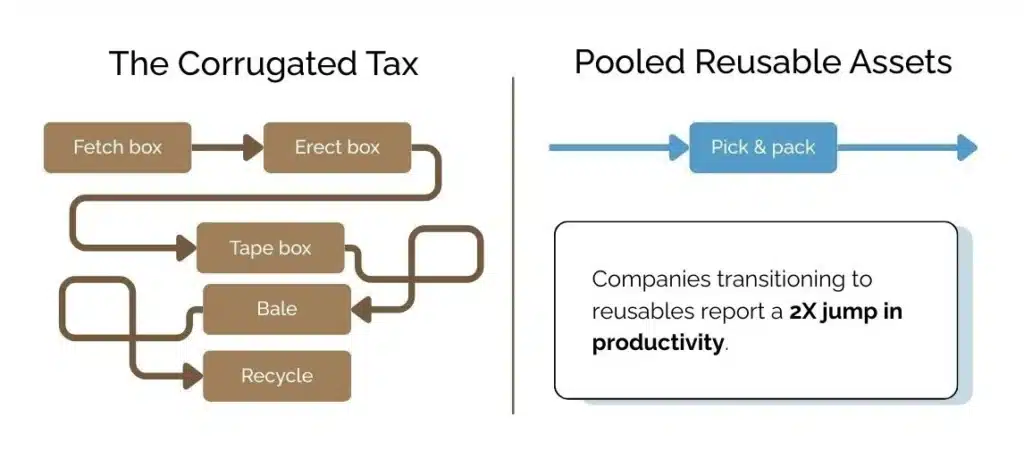
A major driver of cost in corrugated is the significant labor required at every stage of its lifecycle in the supply chain. Boxes need to be erected, taped, broken down, baled, and cleaned up after. All of these tasks pull from a labor pool that, with high warehouse wages and food processing turnover at 36%, is more expensive and harder to replace than ever.
Yet the connection between corrugated and labor costs often goes unnoticed because they are two separate line items in separate budgets. The cost of the packaging decision never shows up in the same place as its labor consequence.
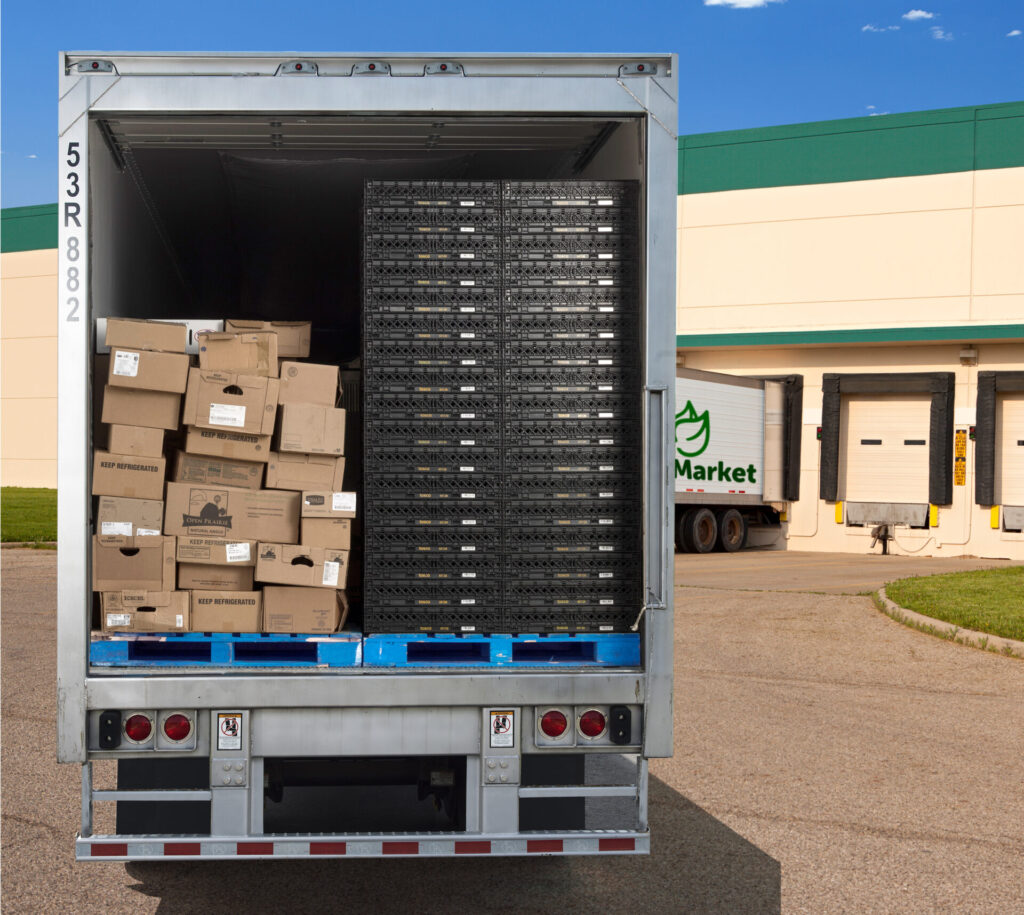
Corrugated was designed before cube utilization was a closely tracked metric. When freight was cheap and stable, a partially loaded trailer was an absorbable cost of moving product.
Corrugated deforms under load and absorbs moisture, so boxes don’t stack or cube out consistently. The result is trailers that run partially filled when they could run full, which means more trips are required to move the same volume. Every shipment that doesn’t fully cube out is paying for space that isn’t being used.
Investment in automated conveyors, sorters, and robotic pickers is accelerating precisely because it reduces dependency on a labor pool that’s expensive and hard to replace. It’s a logical fix, but it creates a new problem when the packaging running through those systems wasn’t designed for them.
Automated systems require dimensional consistency, but that’s something that corrugated doesn’t deliver.
Corrugated introduces dimensional variability as it absorbs moisture or deforms under load. Those inconsistencies lead to conveyor jams, mispicks, sensor errors, and emergency stops; all requiring costly manual intervention. Wooden pallets compound the problem, adding additional failure points into systems not designed for them.
Industry estimates place automation downtime costs between $23,000–$32,000 per hour.

Reusable containers are engineered to be sturdy, moisture resistant, and dimensionally consistent across thousands of trips, and are purpose-built for automated environments.
Supply chain leaders who haven’t yet factored Extended Producer Responsibility (EPR) laws into their packaging strategy are operating with a blind spot. EPR frameworks are expanding across the United States, and many assign fees based on packaging composition, recyclability, and environmental profile.
Single-use corrugated increasingly draws higher EPR fees and compliance costs. For companies selling across multiple states, EcoEnclose estimates a 15–40% uplift on packaging spend in affected states.
Reusable packaging, however, reduces waste volume, supports Scope 3 emissions reporting through better cube utilization, eliminates redundant tertiary packaging materials, and provides the data infrastructure needed for traceability compliance.
“Sustainability has transitioned from a CSR initiative into a core fiscal discipline. With the expansion of EPR laws, your choice of packaging is now a direct determinant of your tax liability and regulatory risk exposure.” — Karin Witton, Global Head of Sustainability, Tosca
Packaging has never been a neutral variable. But in today’s supply chain, where labor is scarce, automation is expensive, retailers are demanding, and regulators are watching — treating it like one is no longer a defensible strategy.
The question isn’t whether hidden packaging costs are eating your margin. They are. The question is how much longer you’ll let them.
Tosca’s pilot program is designed to answer that question with your actual numbers. There’s no upfront cost and no long-term commitment. Tosca designs the pilot around your specific products, routes, and facilities, then builds a customized savings model so you can see what the switch is worth before deciding whether to make it.
Published on March 3, 2026
Updated on March 4, 2026