























Mitigate Your EPR Exposure: Right Packaging Can Save Your SB 54 Costs
Published by Karin Witton, Ph. D, under Regulations

In this article
At a glance: What drives your SB 54 exposure
California’s SB 54 is moving into the fee stage, with recurring program fees beginning in 2027. For food and beverage companies, understanding that cost means looking beyond the package on the shelf.
- Exposure comes from packaging across the supply chain. Primary, secondary, and tertiary packaging are potentially all within the scope of SB 54.
- Packaging weight impacts most fee calculations. Material, format, and plastic-specific charges can significantly change the cost of different packaging components under EPR.
- One-way packaging creates recurring exposure. When new packaging is required with every shipment, its weight and associated fees repeat across annual volume.
Some packaging may have limited room for reduction, while other components may be candidates for elimination, redesign, or reuse.
SB 54 will put a fee on every pound of packaging you can’t defend. Many of the same changes that lower that fee also cut freight, filler, and damage costs. Food and beverage businesses should be asking whether they’ve used SB 54 to evaluate their packaging’s full impact, or only to find the cheapest way to pay for it.
EPR changes the cost equation. Your packaging strategy determines the bigger return.
EPR creates a new, visible cost for packaging, but paying that fee is only one part of what packaging costs a business. A one-way package is purchased, used, and replaced shipment after shipment. Along the way, its design can also affect how much product fits on a truck, how well loads hold up in transit, how much product is damaged, and how much labor is required to handle packaging throughout the operation.
That is why it helps to think of packaging as an operational asset rather than simply a consumable. Reusable secondary packaging can do the same job over repeated trips while also being designed around the broader supply chain: protecting product, creating more consistent loads, supporting efficient handling, and reducing the packaging that must be purchased and discarded with every shipment. EPR may provide a reason to examine the packaging system now, but the larger opportunity is to understand what that system is costing — or contributing — across the operation.

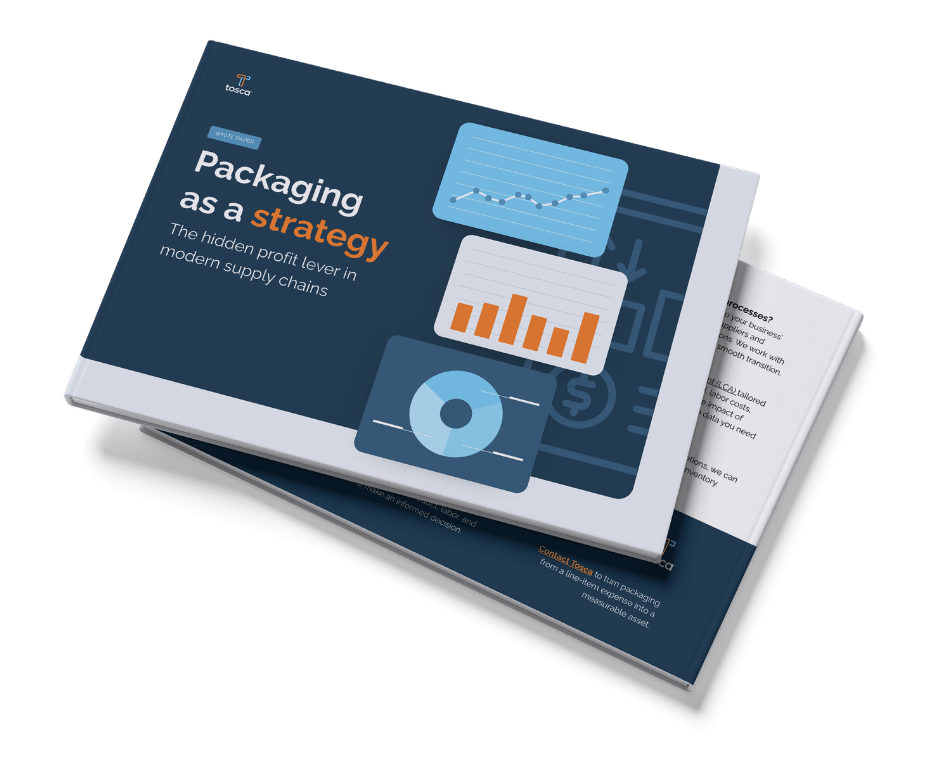
Packaging can be an asset for businesses. Download Tosca’s Packaging as a Strategy to learn how to understand your packaging program and deploy it strategically.
Deep Dive into EPR Exposure
As you shift to a broader view of packaging as a strategy, the immediacy of EPR fees and reduction plans from California’s Circular Action Alliance (CAA) still looms large. Let’s take a closer look at how EPR fees are calculated and the impact of each packaging component.
Weight, material, and type of packaging all matter
Broadly speaking, under SB 54, the amount of packaging you bring into the California marketplace drives your EPR fees, but weight alone doesn’t determine them.
Under *CAA’s initial illustrative 2027 ranges, different packaging formats can carry wildly different base fees and, in the case of plastic, additional surcharges. For example:
- LDPE film can carry estimated fees of roughly 49 cents to $1.09 per pound once plastic-specific charges are included.
- PET clamshells and trays have illustrative base fees of roughly 12 to 36 cents per pound.
- Polystyrene foam trays fall around 47 cents to $1.27 per pound.
- Multi-material pouches are estimated at roughly 59 cents to $1.49 per pound.
*CAA has now published its 2027 California Producer Fees Schedule, which producers should use for current planning. These figures are illustrative, not final, but they show why material and format need to be considered alongside weight when estimating EPR exposure.
Your whole packaging system is in scope
SB 54 doesn’t stop at the consumer-facing package. The law covers single-use packaging, whether it’s primary, secondary, or tertiary: that is routinely recycled, disposed of, or discarded after the contents are consumed or unpackaged. Packaging used to group and protect products as they move through the supply chain can also contribute to EPR exposure.

For a food or beverage company, that might include:
- Primary: The tray, carton, or film holding the product
- Secondary: The case, liner, or other packaging used around it
- Tertiary: The wrap, pallet, or other materials used to move the larger load
And with one-way packaging, those costs are recurring. A case or liner may represent a relatively small amount of material on one shipment, but if a new one is used for every California-bound case, that weight, and its associated fees, is added again and again across annual volume.
This means understanding full exposure requires looking at both the packaging around the product and how often new packaging enters the system.
Reducing EPR fees: The role of primary, secondary, and tertiary packaging
In the near term, many producers will start with the easiest-to-implement primary packaging changes, such as lightweighting (using less material to make the same package). Others will switch from plastic formats to fiber where practical, eliminate unnecessary packaging, and/or replace difficult-to-recycle formats.
Those changes can help reduce fee exposure. But SB 54 also requires producers to address source reduction more broadly through their reduction plans, and the targets increase over time.
Primary packaging has practical limits
Lightweighting and material changes may be the easiest to implement, but primary packaging still has to protect the product, support shelf life, meet food-safety requirements, and hold up through production and transport. There comes a point when making a tray thinner or removing more material from a pouch starts to compromise protection, shelf life, food safety, or performance.
Egg cartons show where the limit sits. Suppliers that pack eggs in foam cartons may face a fee of $0.681 per pound. Lightweighting the foam is the obvious way to bring that number down, but a thinner carton gives the eggs less cushioning. For suppliers and vertically integrated retailers alike, that raises the risk of cracked eggs, which means lost product and a contamination risk for the rest of the carton. The reduction plan adds pressure here too, since the material savings have to hold up without creating new food-safety problems.
That is where sturdier secondary packaging comes in. If the outer layer absorbs more of the impact during handling and transport, the carton doesn’t have to carry all the protection by itself.
Reusable secondary packaging offers additional opportunities
With or without lightweighting, reusable secondary packaging can give companies another place to reduce exposure. Cases, transport containers, and other materials used to move product through the supply chain offset product protection sacrifices resulting from lightweighting, and contribute to material reduction. Replacing qualifying single-use secondary packaging with a reusable system, for example, reduces the amount of new, fee-bearing packaging required for each shipment.
How can reusable secondary packaging reduce EPR fees?
Calculate the exposure
Start with your annual California-bound volume and break the secondary packaging down by component.
EPR example: how a meat supplier might calculate EPR costs
Consider a meat supplier shipping 1 million cases of beef into California each year. If each shipment uses a 2-pound plain corrugated case and a 0.15-pound LDPE mother bag, CAA’s current illustrative 2027 rates put the corrugated portion at roughly $40,000 to $100,000 a year.
However, that much lighter mother bag incurs a higher cost at roughly $74,500 to $164,700 a year once the additional plastic fees are included. Together, the two components create an estimated $114,500 to $264,700 in annual EPR exposure.
That illustrates why the calculation needs to happen component by component. The total tells you what the packaging system could cost under EPR. The next step is figuring out which portion you can actually change.
CALCULATOR: Estimate your EPR exposure
Tertiary packaging belongs in the calculation, too
Tertiary packaging sits farther from the product, but it can still contribute to EPR exposure. Things like stretch wrap, straps,s, corner protection can all potentially be considered covered material under SB 54.

The point is not that every tertiary component can or should be removed. Load containment and product protection still matter. But at this scale, even a fraction of a pound of disposable material per pallet becomes hundreds of thousands of pounds of packaging over a year. That makes tertiary packaging worth evaluating alongside primary and secondary packaging for opportunities to reduce material, redesign the load or replace single-use components with reusable alternatives.
Circularity is where the solution lives
California’s EPR law SB 54 is intended to reduce packaging waste, pushing companies to reuse and move to circular systems. It’s a mindset shift:instead of changing the characteristics of a single-use package, how can you cut down the amount of one-way packaging going into the system entirely.
How reusable secondary packaging helps with Reduce, Reuse, and Recycle
Many packaging materials date back hundreds of years, when there was less concern about the environment, production was more localized, and there was no automated equipment. The business case for change is clear; the perceived pain of the change itself causes pause. That’s where choosing the right circularity partner comes into play. SB 54 recognizes this, and even includes and defines reuse requirements:
- Durability
- Infrastructure for safe reuse
- Repeated recovery
- Inspection and repair when necessary
- Reissuance into the supply chain
That makes recovery, tracking, cleaning, inspection, and redistribution part of the equation. For many businesses, this can be a challenge to implement on their own. Working with a reusable pooling partner offers access to reusable infrastructure without requiring them to build and manage a container network themselves.
Tosca supports EPR compliance and reusable strategies
With Tosca’s pooled reusable packaging model, you don’t have to build or manage a reusable packaging system on your own. Tosca owns the reusable assets and manages the recovery, washing, inspection, tracking, and redistribution needed to keep them in circulation.
Customers may still have EPR obligations tied to other packaging in their supply chain. But for the packaging Tosca owns and manages, the pooling model can reduce both reliance on one-way packaging and the administrative burden that comes with managing those assets.
Because Tosca owns the reusable assets in its pooling system, Tosca handles the EPR reporting associated with those assets. That means customers don’t have to take on that administrative work for the Tosca-owned packaging they use.
Talk with Tosca about where reusable secondary packaging could fit in your supply chain.
Published on October 9, 2026
Updated on October 12, 2026
About the author

Related resources
Regulations

News
The food supply chain is running out of room to absorb fuel costs
Fuel surcharges are back on the table. For anyone in food and grocery supply chain, that’s not a surprise. The...
News
How Tosca Is Powering Product-First Automation in Modern Manufacturing
Automation has moved from a “nice-to-have” to a manufacturing essential and at the center of successful automation is the product...